
OY Programs Were Preserved in FY26 Funding Bill, But Faced Cuts Again
by Thomas Showalter
On Tuesday, February 3, President Trump signed a massive “minibus” that included complete funding bills covering the Departments of Education, Labor, and many others, as well as two-week stopgap funding for the Department of Homeland Security (DHS).
How Minnesota ICE operations changed the equation: The killing of Alex Pretti on January 24 stalled final passage of the minibus, leading to a short, partial government shutdown. The DHS bill funds the U.S. Border Patrol and Immigration and Customs Enforcement (ICE), the latter of which many Democrats in Congress want to see reformed or abolished. It’s unlikely that a compromise will be reached on DHS funding before the stopgap ends, triggering the need for another stopgap or shutdown of some DHS agencies. (Though likely not ICE, which received billions of dollars in new funding in last year’s Big Beautiful Bill.)
The significance of appropriations bills vs. continuing resolutions: Compared to continuing resolution(s), which simply extend the life of a previous appropriations bill, passage of a full Labor-Health and Human Services (LHHS) bill represents an important endorsement by Congress. Appropriations bills give members of Congress a chance to make modifications to programs if they like, and the final text reflects an implicit endorsement by Congress of the programs contained and how they operate. The LHHS bill changed little about programs serving Opportunity Youth (OY), rejecting proposals in President Trump’s budget that would have eliminated WIOA Youth, Adult Education, Job Corps, and AmeriCorps funding.
The LHHS bill includes targeted language to protect existing programs, such as a prohibition on unilateral closure by the executive branch of Civilian Conservation Centers and Job Corps Centers – unless they meet existing statutory and regulatory requirements for closure.
This LHHS bill could have been much, much worse. However, federal support for youth employment and training continues to die by a thousand cuts.
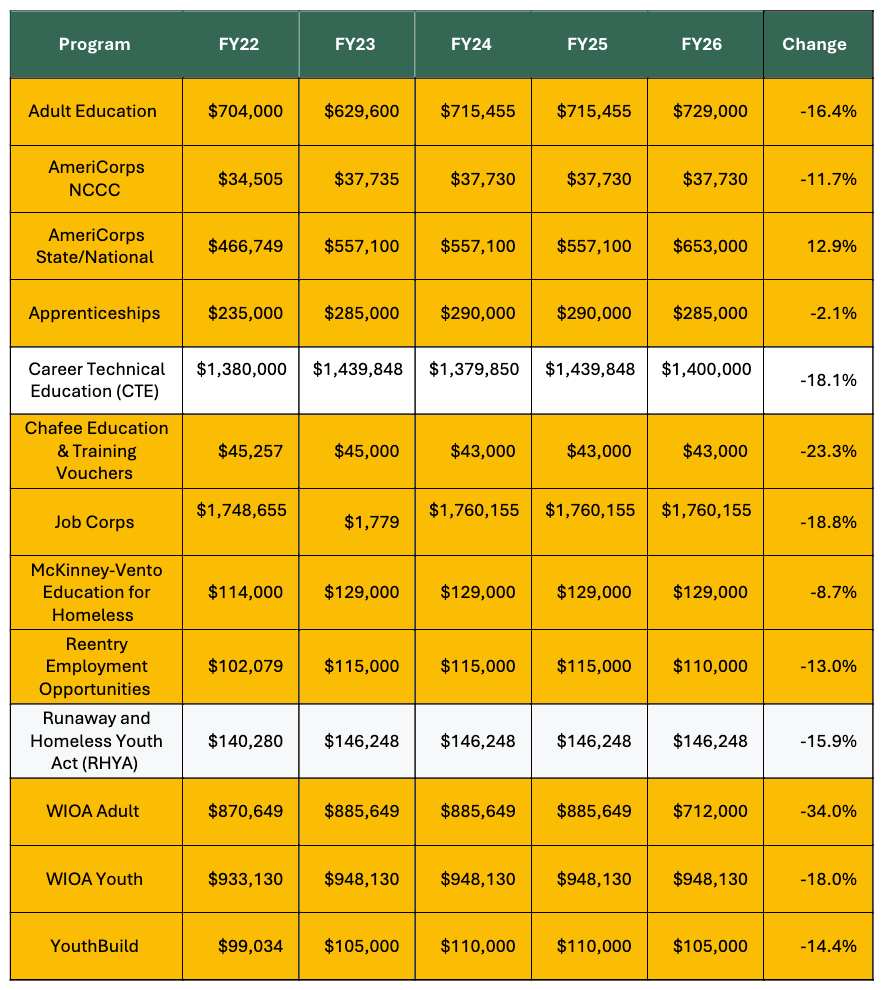
“Level funding” = cuts: Years of “level funding” equates to cuts, as inflation eats into the value of the money appropriated by Congress to different programs. As Table 1 shows, nearly all line items targeted by the Reconnecting Youth Campaign (RYC) have faced significant declines over the past five years in inflation-adjusted dollars.
For example, WIOA Youth Services formula funding will be funded at the same dollar amount for the fourth year in a row. To keep pace with inflation just over the past four years, this line item would need to be $144 million higher in FY26 than the $948 million included in the LHHS bill. The only exception is AmeriCorps State and National, which has seen a modest increase – a testament to the ingenuity and commitment of national-service advocates.
Table 1: Funding for OY Programs Keeps Going Down (Nominal Funding for OY-Related Line Items, FY22-26, In Thousands; Change in Inflation-Adjusted Dollars; Orange = RYC Line Items)
Much more needs to be done: The nation faces grave challenges from job shortages, and industry transformations. Today’s young people will be the first casualties of some of these changes – but Gen Z is also our most adaptable and tech-savvy generation ever.
Apprenticeship as an example: Even funding for apprenticeships, a bipartisan priority across many presidential administrations, has declined in inflation-adjusted terms over the past five years. President Trump set a goal of 1 million active apprentices; there are currently around 800,000. But, to fill all the shortages in readily apprentice-able jobs in construction, healthcare, and manufacturing, we need millions more apprentices. We need a surge of funding toward this bipartisan, time-tested approach – and it needs to ensure that young people (in- and out-of-school) can take advantage.
While pleased with passage of a comprehensive LHHS bill that rejects proposed cuts, the Reconnecting Youth Campaign will take the message to Members of Congress and the Trump Administration that we need a surge of funding toward bipartisan, time-tested programs serving Opportunity Youth. We hope you’ll join us in upcoming meetings and throughout the year.
Thomas Showalter is an independent consultant assisting nonprofits with policy change, program implementation, fund development, and communications, as well as a subject matter expert in areas including K-12 education, workforce development, and disability. Thomas was previously executive director of the National Youth Employment Coalition, served on the staff of the U.S. Senate Health, Education, Labor, and Pensions Committee, and worked in various roles at public-affairs and public-relations firms.
